
surf ‘n’ turf page 3
The weather may be warm on-shore, but working for hours at the water’s edge is usually really cold. So wrap up warm, wear Wellington boots and take a packed lunch. I sit on a tripod-style stool and use a monopod, to save tired legs and arms. The incoming tide can be a problem as a freak strong wave can catch you out and soak you up to the knees or even higher! Also, the tide can sneak in behind you and leave you marooned, easily done if concentrating on the surfers.
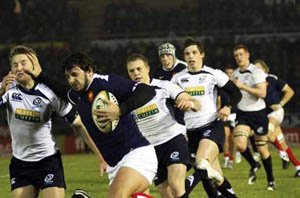
ABOVE: Here the action is so tight to the try
line that only 125mm of focal length is
needed to frame the French forward. One
of the ever-present dilemas for the sports
photographer is when to drop the 400mm
lens and shoot with their 70-200mm zoom!
In competitions, there are normally four surfers in the water wearing coloured bibs. Snaps of the red- or yellow-bibbed surfers tend to make more dramatic shots as they stand out more. Catching a clear view of the surfer’s face is normally a must. The best shots are:
· Looking directly down a barrel/tube wave with the surfer coming towards you, totally enveloped by the curling wave
· Aerial shots where the surfer takes off and has plenty of air between the top of the wave and the board
· Snap turns at the top of the wave which produce dramatic wave spray
· When the sun is low and shining behind the waves, dramatic silhouettes can be snapped
Rugby is a game that has certain unique characteristics from the photography standpoint. In soccer you can almost guarantee that there will be action around the goal mouth, a well-defined area of the pitch. In rugby the try line extends the width of the pitch, some 70 metres. A crucial phase of the game may therefore be under your nose or almost out of sight! Small wonder then that rugby photographers may be seen squinting through their 400mm lenses while nervously fingering a 70–200 zoom around their necks!
For this section we approached James Gunn, a Societies’ member (and a Sports Photographer of the Year) from Caithness in Scotland. If London photogs complain about having to find their way across London to Twickenham explain to them that the nearest top-class ground to James is five hours’ drive away, in Edinburgh! At recent international matches James was allocated spots on the try line and captured the action with his 70–200mm zoom. This is surprisingly short for a field sport but in rugby you often find large clusters of players concentrated around a ruck, scrum or lineout and, in addition, the height reached by lifted players at lineouts requires quite a large field of view. For open play it is in the lap of the gods whether the action is within reach of your lens at any one time. Conversely, a try may be scored literally right under your nose, a little over 15 yards away and there is never any netting in the way!
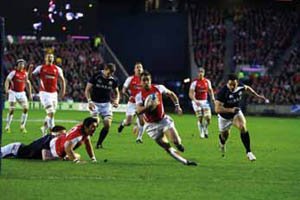
ABOVE: Shane Williams breaks through the Scotland defence, encouraged by James Hook . The try line is in view and the story of the picture is complete including the celebration of the forward in the left of the picture. The space to the right of the chasing Scotland player is cropped, it adds nothing to the narrative and additonal image area is gained from the extra height to further fill the page. Note that the distracting lights in the top left have forced the choice of placing the title to the right. Finding space for text is always a problem for the page designer.
Join The Society of International Sport & Leisure Photographers today!

Society of International Sport & Leisure Photographers (SISLP) is a trading name of BPPA Ltd
Clwyd Chambers, Clwyd Street, Rhyl, Denbighshire, LL18 3LA, UK
BPPA Ltd Company Reg 0392 2894
VAT number 790 4289 05
Tel: 01745 356935
Corporate Partners


Newsletter
Subscribe to the Societies Newsletter. Subscribe here.
Privacy - London Photography & Video Show - Europe's Largest 'All-Welcome' Photographic Convention
Update cookies preferences